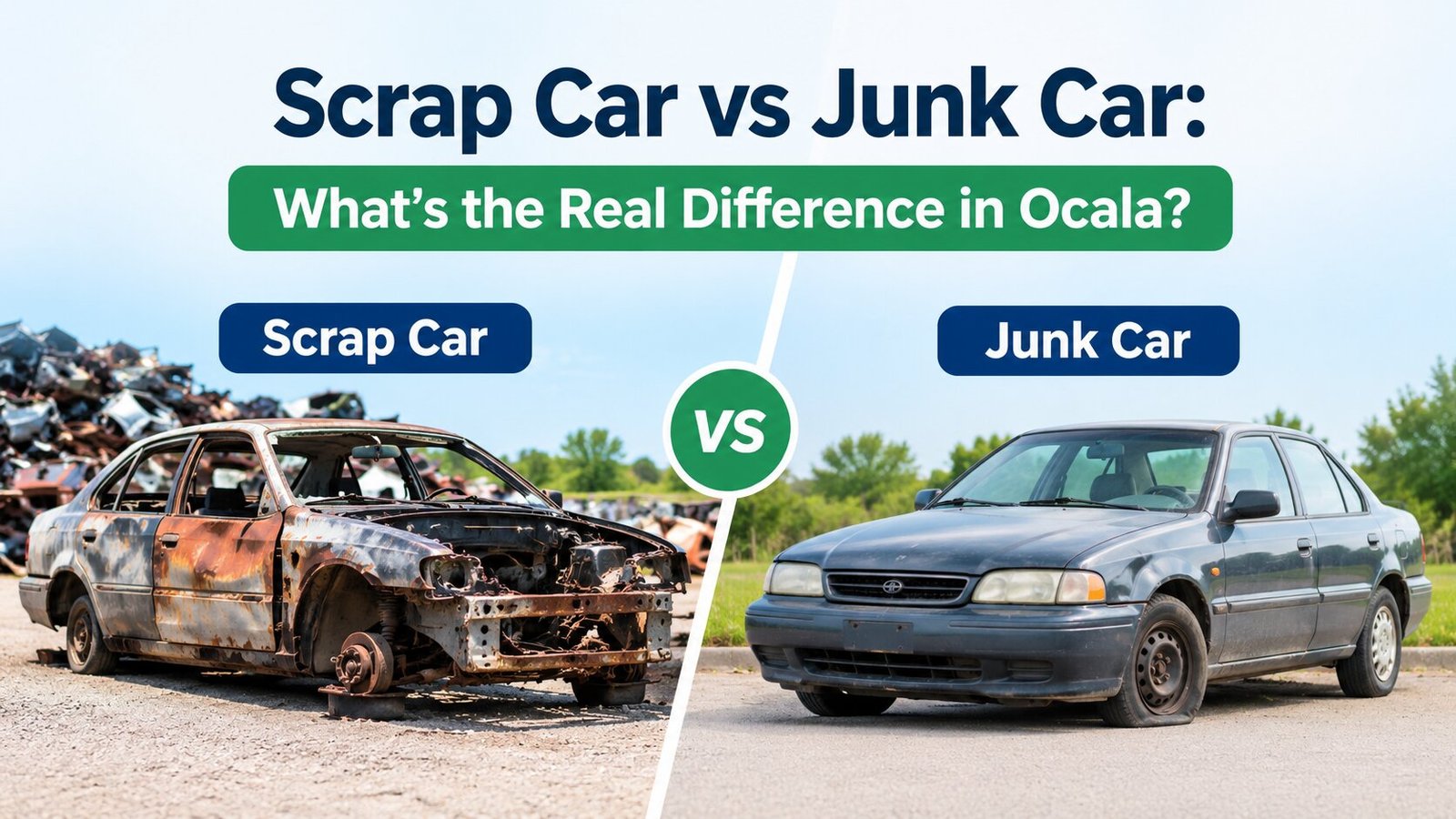
If you have an old or damaged vehicle in Ocala, you have probably seen both “junk car” and “scrap car” used as if they mean the same thing. Sometimes they do. Sometimes they point to different outcomes for your vehicle and different kinds of offers.
The short version is that “junk car” is a broad everyday label for a vehicle its owner no longer wants or can no longer use. “Scrap car” usually describes a vehicle whose main remaining value is in its metal and recyclable materials. Neither term has one universal definition, and buyers, salvage yards, and recyclers do not all use them the same way.
Knowing how the terms overlap helps you describe your vehicle accurately and compare offers sensibly. If you are already leaning toward a sale, you can sell your junk car in Ocala once you know which situation fits your vehicle best.
What Is a Junk Car?
A junk car is a general, informal term. Most people use it for a vehicle that is old, damaged, unreliable, unwanted, or no longer running. It describes how the owner sees the car, not a formal category.
A junk car might be:
- A car with a failed engine or transmission
- A vehicle with collision damage that costs more to fix than it seems worth
- A car that has sat unused and no longer starts
- An older vehicle with a long list of problems
- A car that is simply taking up space
The word says little about what the car is actually worth. A vehicle can be junk to you and still contain parts someone wants. For a closer look at what usually qualifies, see this explainer on what qualifies as a junk car.
What Is a Scrap Car?
A scrap car is generally a vehicle considered mainly for its recoverable metal and recycling value. When a car reaches that point, repairing it or reselling it as a drivable vehicle is usually not realistic. It may be dismantled, crushed, or shredded so the metals and other materials can be recovered.
Scrap is a matter of degree, not a switch. A scrap-bound vehicle may still have usable components pulled first, such as certain engine parts, wheels, or electrical components. What remains after that is processed as scrap metal.
Be careful with the label “salvage,” which can mean something different. Salvage often refers to a vehicle that has been damaged and may be repaired, rebuilt, or sold for parts. This comparison of how salvage vehicles differ from scrap vehicles covers that distinction in more detail.
Scrap Car vs Junk Car: The Main Differences
The table below shows how the two terms are commonly used. Treat it as a guide, not a rulebook. Real vehicles often fall between the columns.
| Factor | Junk Car | Scrap Car |
| Typical meaning | Broad everyday term for an unwanted, damaged, old, or non-running vehicle | A vehicle valued mainly for recoverable metal and recycling |
| Typical condition | Anywhere from a car that needs one major repair to one that is heavily damaged | Often severely damaged, very old, incomplete, or beyond practical repair |
| Parts value | Can be significant if components are in demand and in usable condition | May be limited once useful parts are removed, though some may still have value |
| Likely destination | Resale, dismantling for parts, or scrap, depending on the vehicle | Dismantling and metal recycling |
| Valuation considerations | Make, model, condition, completeness, demand for parts, location | Weight and material content, completeness, location, buyer’s process |
| Overlap | Many junk cars end up as scrap cars | Many scrap cars were first called junk cars |
The main point is that “junk” describes your view of the car, while “scrap” describes where it is most likely headed. A buyer’s advertisement may use either word without telling you how your vehicle will actually be processed.
Can a Junk Car Still Have Value Beyond Scrap Metal?
Yes, it can. This is the part many owners overlook.
A car that does not run is not automatically a scrap car. Depending on the vehicle, some components may still be reusable. Examples include body panels, wheels, certain engine or transmission components, and electronics. Whether any of that matters depends on the make, model, year, condition, and demand for those parts.
On the other hand, a car that looks fine on the outside may have problems that reduce its value. A hidden mechanical failure or missing major components can change the evaluation quickly.
A few things to keep in mind:
- Running condition is only one factor. A vehicle that starts can still be a poor candidate for resale, and a vehicle that does not start can still have worthwhile parts.
- Completeness matters. A vehicle with missing major components may be evaluated differently from one that is intact.
- Demand varies. Some vehicles have parts that are in higher demand than others.
Because of this, the label “junk” or “scrap” alone should never determine your expectations. The actual offer for your specific vehicle is what counts.
How Vehicle Condition Affects a Cash Offer
Buyers generally look at the vehicle itself. While every buyer has their own process, these are common things that may affect an offer:
- Engine and transmission condition. Major mechanical failure may reduce resale potential, though it does not always remove all value.
- Collision or body damage. Extensive damage can push a vehicle toward dismantling or scrap, while limited damage may leave more options open.
- Missing parts. Missing catalytic converters, engines, wheels, or other major components can change how a buyer sees the vehicle.
- Overall completeness. An intact vehicle is usually easier to evaluate than one that has been partly stripped.
- Make, model, and year. These influence how in-demand certain parts are.
- Location and access. Where the car is parked and how easily a tow truck can reach it can affect the logistics of removal.
Scrap metal prices do change over time, and recoverable materials can contribute to value. No honest buyer can tell you a number without knowing your vehicle, so be cautious about any estimate given without details.
How to Decide Whether Your Car Is Junk or Scrap
You do not need to settle on a label before asking for an offer. Still, a quick self-check can help you describe your vehicle clearly. Ask yourself:
- Does the vehicle start and run, or does it not run at all?
- Is the damage mainly cosmetic, mechanical, or structural?
- Is the engine or transmission still in place and intact?
- Are any major parts missing?
- Would a repair likely cost more than the vehicle is worth to you?
- Do you know the make, model, year, and approximate mileage?
- Do you have the title or ownership documents available?
- Can a tow truck reach the vehicle easily?
If your answers describe a vehicle with some intact, usable components, “junk car” is probably the more natural term, and parts value may be worth asking about. If the vehicle is badly damaged, incomplete, or far past practical repair, it may be heading toward scrap. If you are unsure, describe the vehicle honestly and let the buyer explain how they would evaluate it. The guide to common types of junk vehicles can help you recognize which condition best matches yours.
What Ocala Vehicle Owners Should Know Before Selling
Ocala drivers end up with unwanted vehicles for ordinary reasons. A car breaks down and repairs cost too much. A collision leaves a vehicle not worth fixing. An older family car sits in the driveway for months. In each case the terminology matters less than the practical questions below.
Compare the offer and the removal terms, not the label. A buyer who says “scrap car buyer” and one who says “junk car buyer” may handle your vehicle in similar ways. Ask what the offer is based on and what the removal arrangements are. If you are comparing types of businesses, this breakdown of how a junk car buyer differs from a local junkyard is a useful starting point.
Ask about pickup before you assume it. Free pickup may be available for qualifying vehicles, but the details depend on the vehicle and its location. Confirm arrangements before agreeing to anything.
Clarify documentation early. Do not assume paperwork will be simple. According to the Florida Department of Highway Safety and Motor Vehicles (FLHSMV), when a titled vehicle is junked, the title is generally provided to the salvage dealer and the seller signs the transfer section. If the title is not available, FLHSMV says a duplicate title application (Form HSMV 82101) may be needed first. Requirements can vary by situation, so ask the buyer what they need and check current FLHSMV guidance for your circumstances.
Think about the license plate. FLHSMV also provides instructions on surrendering plates when a vehicle is junked. It is worth asking about before the vehicle leaves.
Have your information ready. When you ask for an offer, it helps to know:
- Year, make, and model
- Approximate mileage
- Whether it runs
- What damage or mechanical problems it has
- Whether any major parts are missing
- Where the vehicle is located and whether it is easy to access
- What ownership documents you have
For a fuller walkthrough of the process, see this step-by-step selling guide for Ocala owners.
Frequently Asked Questions
Is a junk car the same as a scrap car?
Not always. “Junk car” is a broad, everyday term, while “scrap car” usually points to a vehicle valued mainly for its metal. The two overlap, and many junk cars do end up as scrap after useful parts are removed.
Is a non-running car automatically a scrap car?
No. A car that does not run may still have reusable parts or other value, depending on its condition, completeness, and demand for its components. Running condition is one factor among several.
Can a junk car still have value?
It can. Value may come from reusable parts, resale potential, or recoverable metal. The amount depends on the specific vehicle and the buyer’s evaluation.
What affects the offer for a damaged or wrecked car?
Common factors include the extent of the damage, engine and transmission condition, missing parts, the vehicle’s make, model, and year, and its location and accessibility for towing.
Do I need my title to sell a junk car in Florida?
FLHSMV guidance indicates the title is generally provided to the salvage dealer, and a duplicate title may be needed if the original is unavailable. Ask your buyer what documentation they require and confirm current rules with FLHSMV.
Final Thoughts
The difference between a scrap car and a junk car is mostly about perspective and likely outcome. “Junk” describes how an owner sees the vehicle, while “scrap” describes where it is probably headed. What matters most is the actual condition of your vehicle and the actual terms of the offer.
If you have a vehicle you no longer want, gather the details from the checklist above and request a quote. Offers depend on the vehicle, so the more accurately you describe it, the more useful the response will be.