If you’ve got an old car sitting in the yard off SR-44, or a truck that finally gave out somewhere between Lecanto and Beverly Hills, the first question is almost always the same: what’s this thing actually worth?
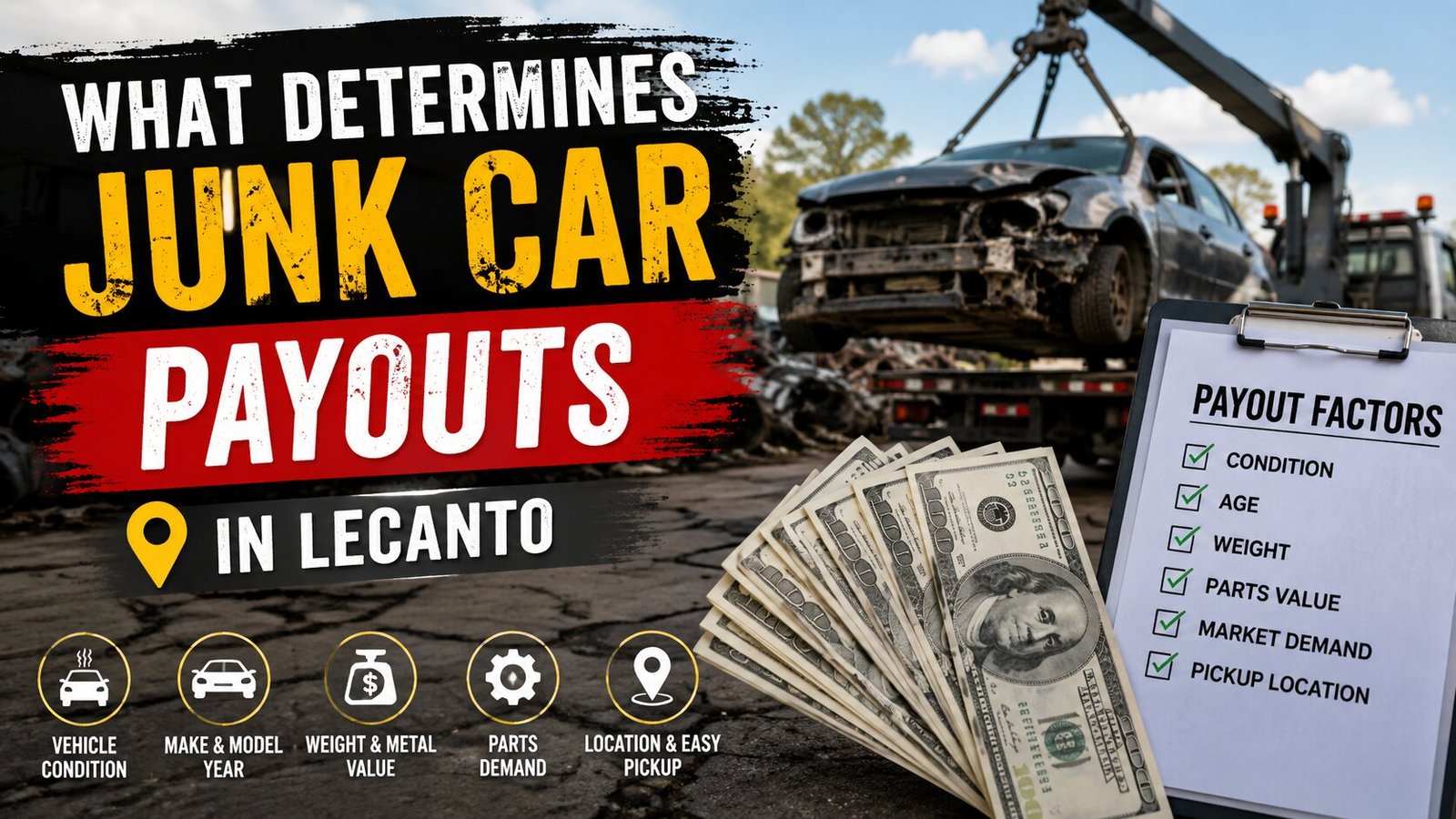
There’s no single number that applies to every vehicle, and anyone who tells you a flat rate over the phone without asking a single question is usually guessing. Junk car payouts come down to a handful of specific factors, and once you understand them, you can get a realistic idea of what to expect before you ever request a cash offer.
This matters more in a place like Lecanto than it might in a dense city. Lecanto is unincorporated, spread out along State Road 44 between Crystal River and Inverness, and a lot of vehicles here sit on rural lots or long driveways rather than curbside in a neighborhood. That changes a few things about how a vehicle gets valued and picked up, which we’ll get into below.
Why Junk Car Prices Aren’t One-Size-Fits-All
Every junk or scrap vehicle is really two things at once: a source of scrap metal and, potentially, a source of usable parts. A buyer looks at both. A car’s weight determines its baseline scrap value, since scrap metal is priced by the ton. But if the engine still turns over, the transmission is intact, or the catalytic converter hasn’t been stripped, that pushes the value up beyond scrap weight alone.
This is why two cars that look similarly beat-up from the outside can get very different offers. One might be picked clean already. The other might still have a working alternator, an intact wiring harness, or tires with tread left on them.
Vehicle Condition Is the Starting Point, Not the Whole Story
Condition gets evaluated on a few levels:
- Does it run and drive, or does it need to be towed?
- Is the damage cosmetic, or is it structural (frame damage, flood damage, fire damage)?
- Is the interior intact, or has it been sitting exposed to the elements?
- Are major components (engine, transmission, catalytic converter) present and complete?
A non-running vehicle isn’t automatically worth less than a running one. A car that won’t start because of a dead battery or a blown head gasket can still have a fully intact drivetrain worth more in parts than a running car with high mileage and worn-out internals. That’s the logic behind selling a non-running car for real money instead of assuming it’s only good for the crusher.
Damaged vehicles work the same way. A car that’s been in an accident might look rough, but if the damage is concentrated on one end, the rest of the vehicle can still hold significant parts value. That’s why cash offers for damaged cars vary so much depending on where the damage is and what’s still salvageable underneath it.
Parts Value Can Outweigh Scrap Value
This trips people up more than anything else. A lot of owners assume a car with a bad transmission or a cracked block is only worth scrap metal price. Sometimes that’s true. But if the car is a common make and model with parts that are still in demand, a buyer may value it higher because those individual components can be resold rather than melted down.
Wheels, catalytic converters, alternators, starters, and body panels in decent shape all factor in separately from the vehicle’s weight in scrap steel. If you’re weighing whether to sell a car whole or try to part it out yourself, it helps to understand how selling a car for parts is evaluated differently than a straight scrap sale, since the labor of pulling parts yourself has to be weighed against the time it takes and the price a buyer will pay for the whole vehicle intact.
Mileage and Year Still Matter, Just Less Than People Expect
High mileage on a running car can lower its value if the buyer is assessing it for resale potential. But on a vehicle that’s already being sold as junk or scrap, mileage matters less than most people assume, since the car isn’t being valued as functional transportation anymore. What matters more at that point is what’s mechanically intact and what isn’t.
Title Status and Paperwork
Proof of ownership affects both the offer and how quickly a sale can close. A clean title in your name is the simplest scenario. If the title is lost, if the car was inherited, or if it’s registered to someone who’s no longer around to sign, that adds a step, not necessarily a dead end.
This is common enough in a county like Citrus that it’s worth planning for ahead of time rather than being surprised by it during pickup. If your situation involves a missing or complicated title, it’s worth reading through how to sell a junk car in Lecanto without title before you request a quote, since knowing what documentation you can substitute will save you a back-and-forth later.
Location and Towing Logistics
This is the part that’s genuinely different depending on where you live, and it’s relevant to Lecanto specifically. A vehicle sitting on a paved city street with easy tow truck access is straightforward. A vehicle parked on soft ground, down a long dirt driveway, behind a locked gate, or on a rural property off a county road is more complicated to reach.
None of that automatically kills the deal, but it’s worth mentioning when you request your offer. Flat tires, a vehicle that’s sunk into soft or wet ground, or limited turnaround space for a tow truck can all affect how straightforward the pickup is. Being upfront about accessibility when you first describe the vehicle helps avoid a mismatch between the quote and what the tow crew actually finds on arrival.
What to Have Ready Before You Request an Offer
Getting an accurate number the first time comes down to giving a buyer accurate information. Before you ask for a quote, it helps to have:
- The year, make, and model
- Approximate mileage
- Whether it runs, and if not, what’s wrong with it (as best you know)
- Condition of the body, interior, and tires
- Title status, or what documentation you do have
- The general location and any access issues (driveway type, gate, soft ground, etc.)
The more accurate this information is upfront, the less likely the final offer changes once someone actually sees the vehicle in person.
Common Mistakes That Lower a Payout
A few patterns show up often enough to be worth flagging:
Assuming a non-running car is worthless. As covered above, this is frequently wrong. Get it evaluated before scrapping it for parts yourself or letting it sit longer than it needs to.
Waiting too long after a flood or storm. Water damage and prolonged exposure accelerate rust and component failure, which can reduce what’s salvageable the longer a vehicle sits.
Not mentioning existing damage. Leaving out damage during the initial description, whether intentional or just forgotten, usually means the final offer gets adjusted once the vehicle is inspected in person. It’s better to be upfront from the start.
Assuming a missing title ends the process. It usually doesn’t, but it does require some legwork. Not knowing this leads people to hang onto a vehicle far longer than necessary.
What Happens After You Accept an Offer
Once a price is agreed on, the general process for most buyers involves scheduling a pickup time, verifying the vehicle matches what was described, confirming ownership documentation, and completing payment at the time of pickup. If you want a fuller breakdown of what that looks like step by step, this guide on what happens after a junk car buyer picks up your vehicle walks through it in more detail.
Frequently Asked Questions
Does a car have to run to get an offer?
No. Non-running vehicles are evaluated on their own basis, factoring in what parts and components are still intact rather than whether the engine starts.
Will rust or body damage automatically lower the price?
It depends on how extensive it is and whether it affects the frame or major components. Cosmetic rust and dents matter less than structural or mechanical issues.
What if I don’t have the title anymore?
It’s often still possible to move forward, though it may require additional documentation or verification depending on your specific situation.
Does the vehicle’s location affect the offer?
It can, mainly in terms of towing access. A vehicle that’s hard to reach may involve additional logistics, which is why it helps to mention accessibility upfront.
Is scrap value the same as the payout I’ll receive?
Not necessarily. Scrap value is based on weight, but many vehicles are worth more once usable parts and components are factored in separately.
Getting a Real Number for Your Vehicle
If you’re in Lecanto and trying to figure out what your car, truck, or SUV is actually worth, the most accurate way to find out is to describe it honestly and let it get evaluated based on its actual condition, not a generic estimate. Whether it’s running, sitting with storm or accident damage, missing a title, or just taking up space, reach out for a cash offer and find out where it lands. If it qualifies, junk car removal can typically be arranged as part of the process.