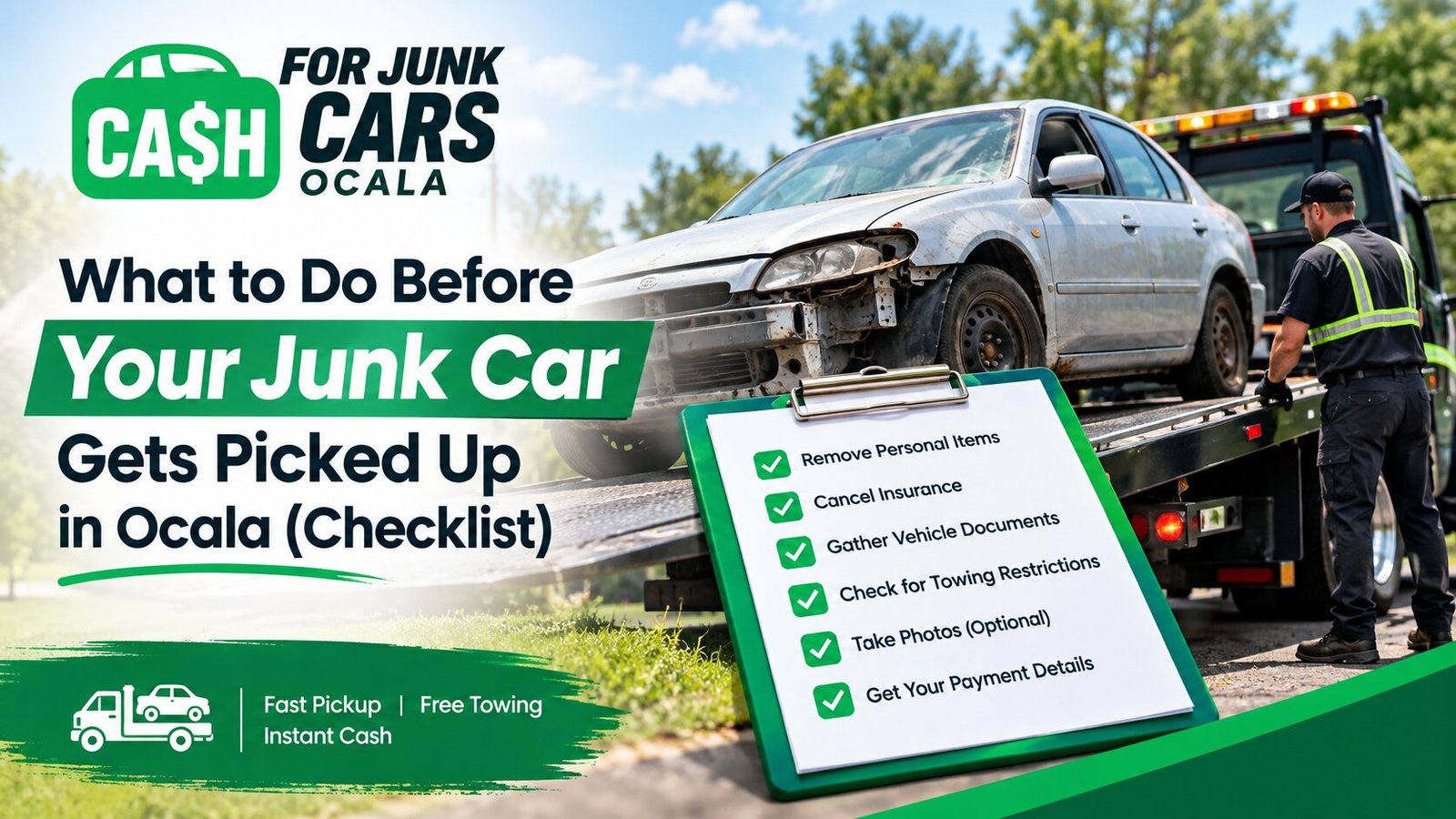
You found a buyer, agreed on a time, and now the car is sitting in the driveway wondering what’s next. A little prep before pickup day usually decides whether the handoff takes ten minutes or turns into a string of phone calls. If you plan to sell a junk car in Ocala, this checklist covers what to do, in roughly the order to do it.
Start with proof that the car is yours
The most common delay in any junk car sale is paperwork. Before anything else, find the title and check that your name on it matches your ID.
If the title is missing, damaged, or still lists a previous owner, don’t panic, but don’t wait until pickup day either. Buyers often need extra verification in those situations, and the requirements depend on the vehicle and the paperwork you have. Tell the buyer upfront what you do and don’t have. It is far easier to sort out before a tow truck is on the way.
Check for a lien
If you financed the car, the lender may still be listed on the title. A vehicle with an unpaid loan generally can’t be sold until that is resolved. Call your lender, ask for the payoff status, and find out what they need from you. Plenty of people assume an old loan was cleared years ago, so it is worth confirming.
Gather the details a buyer will ask for
To give you a realistic offer, a buyer needs to know what they are looking at. Have these ready before you call:
- Year, make, and model
- VIN (on the driver’s side dashboard near the windshield, and on your registration)
- Approximate mileage, or a note that the odometer doesn’t work
- Whether it starts, runs, or drives
- Where it is located and whether a truck can reach it
Being specific helps. “It’s a 2007 sedan that won’t start, flat tires, no major body damage” gives a buyer more to work with than “it’s old and broken.”
Be honest about condition
Condition drives value, and surprises on pickup day tend to lower an offer or cancel it. Note what is wrong with the car, including the things you think don’t matter.
Some details that change how a vehicle is valued:
Missing parts. A missing catalytic converter, battery, engine, or transmission can change the estimate. Say so upfront.
Wrecked or damaged vehicles. Collision damage doesn’t automatically mean the car is worthless. Buyers may still see value in usable parts or scrap metal. If you are unsure how your car is classified, our breakdown of different kinds of junk vehicles can help you describe it accurately.
Non-running cars. A car that won’t start can still have value. Not running is a condition to report, not a reason to assume nobody will make an offer.
Take a few clear photos from each side, plus the interior and any damage. Photos often speed up the estimate and cut down on back and forth.
Clean out everything that’s yours
Once the car leaves, getting anything back from it is unlikely. Go through the whole vehicle, not just the front seats.
Check the glove box, center console, door pockets, trunk, under the seats, and any spare tire compartment. Old registration papers, insurance cards, garage door openers, sunglasses, and loose documents all end up in cars that have been parked a while. Remove anything with your name, address, or account information on it.
Don’t forget the toll transponder
In Florida, a SunPass or other toll transponder stuck to the windshield is easy to forget. If it stays with the car, tolls could be charged to your account after the sale. Peel it off and take it with you.
Sort out your plate and insurance in the right order
In Florida, the license plate generally belongs to you, not the car. Remove it before the vehicle goes. Depending on your situation, you can transfer it to another vehicle or turn it in.
Be careful with insurance. Canceling coverage before the plate is handled, or before the sale is complete, can create problems with your registration. The safest move is to call the Marion County Tax Collector’s office or check with the Florida Department of Highway Safety and Motor Vehicles before canceling anything, since rules can change. Also ask about filing a notice of sale, so the state knows the car is no longer yours.
Think about what you want to keep
Some owners want to keep a few things: a stereo, a set of good wheels, a child seat, a toolbox in the trunk. Decide this before you get an offer, because it can change the price. A car with aftermarket parts removed is valued differently than the same car with them on.
Don’t start pulling major parts off without talking to the buyer first. A vehicle that is partly stripped may be priced differently, and some buyers will pass on it.
Make the car easy to reach
Pickup logistics matter more than people expect. A tow operator needs to get to the vehicle, hook it up, and get it out safely.
Think about where the car is sitting. A few situations that commonly complicate a pickup:
- A car parked behind other vehicles or blocked in
- A locked gate or a long driveway in a more rural part of Marion County
- Soft ground or deep grass, especially after heavy rain
- Flat tires or a locked steering wheel
- A neighborhood or community with parking or access rules
If your car is in Southwest Ocala, closer to Belleview, out toward Silver Springs Shores, or on a larger rural lot in the northwest, mention the access details when you call. A quick note like “gate code needed” or “car is behind the barn” helps the driver plan. If you live in a community with an HOA or gate, it’s smart to tell the gate contact a tow truck is expected.
If the car is on a public street, check that nothing is blocking access and that the vehicle can be legally towed from that spot.
Confirm the details before pickup day
Before anyone shows up, make sure you and the buyer agree on the basics: the offer amount, the pickup location, who needs to be present, and what paperwork to have ready. Ask whether you need to be there in person, since the requirements can vary.
It also helps to ask what happens after the car leaves your hands. If you are curious how junk vehicles are processed, what happens once a buyer takes your car walks through the general process.
If you are comparing how a car might be handled, it also helps to understand the difference between salvage and scrap vehicles, since the two can be valued differently.
On pickup day
Keep it simple. Have your ID, the title, and the keys if you have them. Walk the car one last time to check for personal items. Confirm that the agreed amount and the terms match what you were told. Before you sign, read what you are signing, and keep a copy of the bill of sale or any transfer paperwork.
After the car is gone, take care of the follow-up: turn in or transfer the plate, update your insurance, and report the sale if required. Keep your paperwork for a while in case a question comes up later.
A quick recap
Before pickup: find the title, confirm there’s no lien, note the VIN and mileage, describe the condition honestly, take photos, clear out your belongings, remove the plate and toll transponder, and make sure the car can be reached. Then confirm the details with the buyer.
If you are ready to sell, or you are not sure whether your car qualifies, reach out for a quote. Have your VIN, location, and a few photos handy, and the conversation will move faster.